

To sum up the big promise of AI in manufacturing, it will be able to:
- parse through masses of data to look for an answer,
- query the data with no coding knowledge in natural language,
- generate analysis, trends, and insights…
…so that operators, engineers, and supervisors are able to focus on making decisions. At least that’s where it starts for manufacturers looking to get into it.
The Reality: A building without a foundation
But that’s not where most manufacturers find themselves today. There’s a stark difference between the expectation where manufacturers feel they need to start implementing AI into their processes ASAP and the reality.
The community is quite aware of it too.
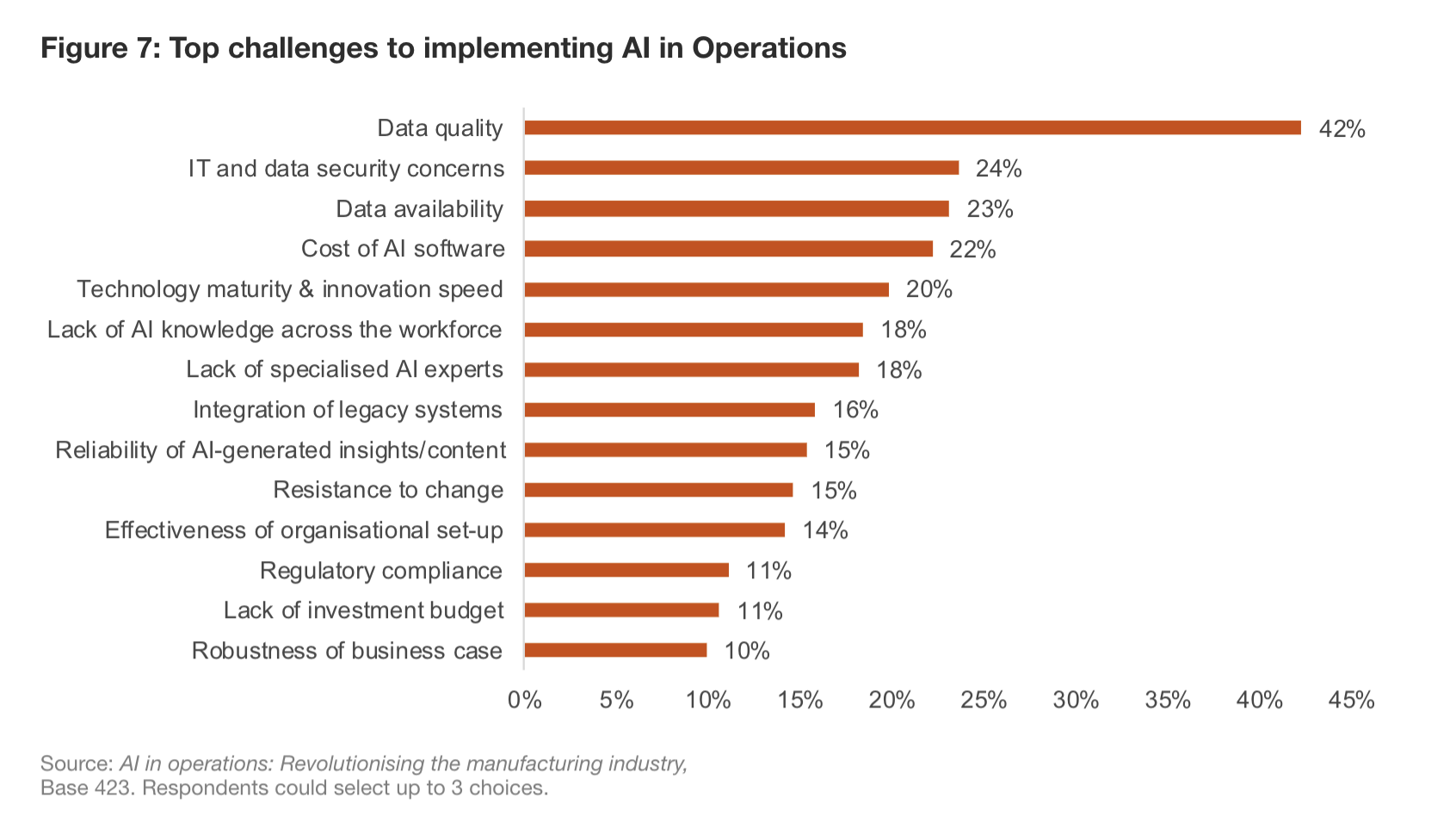
In fact, in a study by pwc and Microsoft, a whopping 42% of the participants named Data quality - or the lack of it - the top challenge in implementing AI.
It becomes apparently that for most players in process manufacturing, trying to immediately implement AI might be like trying to run before you can walk.
The Root Cause: What’s holding process manufacturers back in successfully adopting AI
As things stand, most manufacturers are quite a ways away from realizing that promise of implementing industrial AI. Experts in the industry have said as much too.
Data quality and fragmentation
- Scattered data: According to a MAPI report on AI in Manufacturing one of the biggest challenges for manufacturers is “a lack of interoperability between equipment that precludes the data integration necessary to support AI applications.” Put simply, machines that don’t share data in a common way, data that isn’t combined into a single dataset. Sensors from separate machines, separate systems feeding data into separate databases. Without it, beginning to analyze it becomes impossible.
- Garbage in, garbage out: Data without context and descriptors on what the data represents, what unit should be attached to it, and what the safe margins are, makes analysis a tedious task if it’s done manually, and a potentially inaccurate one if insights are generated using AI. To even start with implementing AI analysis, or calling up info when needed, you need structured, scalable data and that has context attached to it.
AI reasoning is still a blackbox
In an earlier chat, Jeroen Coussement, CEO of Factry, brought up a challenge that’s yet to be addressed:
“LLMs are large complex neural networks which operate like blackboxes.”
It’s difficult to understand how LLMs work and even more difficult to map how they arrive to a certain conclusion. In ideation and creative applications, that’s not an issue.
But while reporting on numbers and data, trust comes from transparency in communicating how the LLM arrived at a certain conclusion, and being accurate every time.
.png)
Data security concerns
In the pwc and Microsoft AI in Operations study, IT and Data Security was the second highest on the list of challenges.
LLMs handle large amounts of sensitive data at the moment without sufficient data protection or security present. Quite a lot of the data in question is private and difficult to access.
The list doesn’t end here, of course. Challenges with trained personnel still persist. Naturally then you ask…
So where should you start with implementing AI in manufacturing?
1. Start with a plan
In some cases, people start with AI as the solution they want to implement, and then look for problems it could solve. But when you’re a hammer, everything looks like a nail. That’s probably the wrong approach.
The right approach: Start with a business case. What problem are you trying to solve with AI? Do you even need AI to solve that problem. If after deliberation, you arrive at a bonafide use case, you can move on to the next step.
2. Collect & Centralize data
.png)
Gather data from sensors through PLC, SCADA, or manually collected data and into a single source-of-truth. With data flowing in constantly from multiple machines, dumped into separate excel sheets, being stored on paper and manually filled out forms, it can be a challenge to know what type of data is stored where.
3. Enrich your Data
a. Add Context to the Data

Add tag metadata and descriptions. Is it a temperature reading? What unit is it in? What are the maximum and minimum values it can take? What is the normal range for this reading?
b. Add Data Semantics and Structure
Enterprise
└── Site
    └── Area A
        └── Line 1
        |   └── Mixer
        |       └── Level
        |       └── Batch
        └── Storage Tank 1
            ├── Material
            └── Level
Knowing how your plants, product lines, machines are related to each other for instance in an asset model can give an AI more context. In this instance it’ll allow it to link for example a pH level reading to the right Storage Tank. Here's how you can do that in Factry Historian.
4. Create Standard Events & Important Calculations
Setting up a time-window or Events that reflect the way you work can help to calculate and compare aggregates between those events. For instance, if batch monitoring is an interesting use case for AI implementation, you can set up a production batch as an event, you might be able to monitor the amount of energy a batch consumed, and compare it to a baseline.
And sometimes a measurement itself might tell only part of the story. Let’s say you want to know the energy efficiency of a process every minute and you want AI to retrieve that information. For that, you’ll want to set up Calculations for KPIs you actually want the AI to retrieve eg. Energy consumed / Quantity produced.
In a nutshell, the more context, structure, and relationships you can set up for the data, the more confident you can feel feeding that to AI, and the more you can trust its suggestions.
5. AI Analysis
By investing in the quality of your data, and building a strong data foundation, you’re well prepared for AI analysis.
There’s two ways to do this:
- Export the data to an AI analytical platform: With an open platform like Factry Historian, it is just as easy to collect data as it is to export it and integrate it with your analytical platform of choice.
- (Coming soon!) Ask Factry Historian questions like a human: The MCP Server for Factry Historian is on the way. Soon you will be able to ask it to plot the temperature on Mixer 2 for Batch 412 or to pull up a report. We can’t wait to share more soon!
Something to look forward to
To summarize, the status quo is unsustainable given the ambitions of manufacturers to go from nothing to everything. But they’re missing a couple steps: A reason to implement AI, and a solid data foundation that can support it.
Bottomline: Depending on which stage you’re in, Factry can already help you go from no data collection, to data ready and getting AI insights. Reach out for a quick demo!

.png)